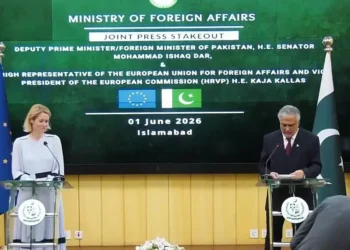
EU High Representative Kaja Kallas said Europe’s security outlook has changed sharply, describing Russia as a direct threat and hybrid warfare as intensifying across the continent. She noted instability in the Middle East and China’s long-term challenge to European interests.
Additionally, the transatlantic relationship is evolving, with the United States urging European partners to assume greater responsibility for defence. Europe is increasing spending and capabilities accordingly. Kallas stressed that stronger European forces reinforce NATO rather than compete with it.
Kallas also highlighted a joint initiative by five countries to develop low-cost air defence systems to protect European skies. Additionally, work is under way with European Commission President Ursula von der Leyen on a new European security strategy.
Meanwhile, continued support for Ukraine and additional sanctions against Russia remain central policy tools. Kallas said the EU expects to release funds from a €90 billion loan package starting in April to sustain Ukraine’s defence and recovery efforts.
Rising Security Pressures Across Europe
Europe faces a more complex threat environment than at any time in recent decades, according to the European External Action Service. Russia’s full-scale invasion of Ukraine remains the most immediate concern, while instability in neighbouring regions continues to shape defence planning across the bloc.
Moreover, Kaja Kallas stated that hybrid threats are expanding even as conventional fighting in Ukraine slows in places. Cyber attacks, sabotage incidents and drone incursions are increasingly used to destabilise European societies without triggering open conflict. As a result, governments are prioritising resilience alongside military strength.
In addition, the European Union has responded with coordinated sanctions, tighter monitoring of Russian diplomatic activities and operations against maritime networks described as Moscow’s “shadow fleet.” These measures are intended to disrupt sanctions evasion and limit Russia’s ability to finance its war effort.
Hybrid Threat Response Measures
EU institutions and member states are strengthening defensive tools against non-traditional attacks. Furthermore, specialised response teams have been deployed to partner countries considered at risk of destabilisation activities.
- Cyber defence expansion: Increased funding and coordination across EU agencies.
- Counter-sabotage operations: Enhanced protection of infrastructure and energy networks.
- Diplomatic controls: Tighter oversight of Russian diplomatic movements within EU territory.
Air Defence Cooperation and Strategic Planning
A central outcome of the meeting in Kraków was agreement among five European countries to pursue low-cost air defence systems. Meanwhile, planners see this as an efficient way to close capability gaps while avoiding excessive spending.
Additionally, the initiative reflects a broader shift toward collective procurement and interoperability. European leaders emphasise that such projects strengthen NATO by improving Europe’s ability to contribute credible forces to the alliance.
European Defence Priorities in 2026
| Air defence development | Joint low-cost systems to protect European airspace |
| Defence spending | Record national investments across EU states |
| Security strategy | New EU-wide framework under preparation |
| NATO coordination | Focus on complementing alliance capabilities |
New EU Security Strategy
Work on a comprehensive European security strategy is under way, led jointly by Kaja Kallas and Commission President Ursula von der Leyen. Furthermore, the initiative aims to align defence investments, crisis response mechanisms and industrial policy across member states.
Meanwhile, officials stress that stronger European capabilities are necessary as global power dynamics shift. The United States continues to support NATO but expects European allies to carry a larger share of defence responsibilities.
Ukraine Support and Sanctions Policy
Support for Ukraine remains a central pillar of EU security policy. In addition, Kallas confirmed that a €90 billion loan package is progressing, with initial disbursements expected in April. These funds are intended to stabilise Ukraine’s economy and sustain defence operations.
Moreover, negotiations between Russia and Ukraine have shown limited progress, with Moscow maintaining maximalist demands, according to EU officials. As a result, the EU plans to intensify pressure through economic measures rather than reduce sanctions.
“Sanctions are working, they are severely hurting Russia’s economy, and each new measure further limits its ability to wage the war,”
Kallas said during the press conference.
She added that sustained pressure is necessary because Moscow will not end the conflict unless the costs outweigh the benefits.
Furthermore, the EU intends to adopt its twentieth sanctions package against Russia in the coming days. Officials argue that continued economic pressure, combined with military assistance to Ukraine, remains the most viable path to a sustainable settlement.
In Conclusion
Kaja Kallas framed the Kraków meeting as part of a broader shift toward a more self-reliant Europe within NATO. Meanwhile, the EU is pairing practical capability projects such as joint air defence with continued Ukraine funding and expanded sanctions planning.
As a result, European defence policy in 2026 is moving toward stronger coordination, faster procurement and sustained pressure on Russia.
Sources: European External Action Service.
Prepared by Ivan Alexander Golden, Founder of THX News, an independent news organization delivering timely insights from global official sources. Combines AI-analyzed research with human-edited accuracy and context.