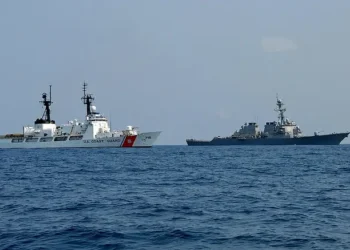
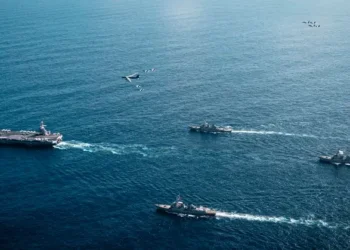
The U.S. 7th Fleet confirmed that Exercise Sea Dragon 2026 concluded March 28 at Andersen Air Force Base, Guam, after 20 days of multinational antisubmarine warfare training involving U.S. and Indo-Pacific partner nations. The exercise focused on improving interoperability, maritime domain awareness, and coordinated submarine tracking capabilities among allied forces.
Exercise Sea Dragon is an annual multinational training event designed to strengthen cooperation among Indo-Pacific partners. Held since 2019, the exercise brings together maritime patrol aircraft and personnel to improve operational coordination and readiness in a strategically significant region.
Exercise Sea Dragon 2026 concludes after multinational training operations in Guam.
Sea Dragon 2026, hosted by Commander, Task Force 72 under the U.S. Navy, brought together forces from the United States, India, Japan, Australia, and New Zealand. Meanwhile, two U.S. Navy P-8A Poseidon aircraft from Patrol and Reconnaissance Squadrons 4 and 45 operated alongside partner aircraft in Guam and surrounding areas.
Additionally, the exercise lasted 20 days, reflecting a sustained operational training cycle aimed at improving joint readiness. As confirmed by U.S. 7th Fleet Public Affairs, the exercise supports long-term maritime security objectives in the Indo-Pacific.
Overview of participating nations, aircraft, and hosting command involved in the exercise.
Participating forces included maritime patrol aircraft from five nations, all operating the P-8A Poseidon platform for coordinated antisubmarine warfare missions. Additionally, operations were conducted in the vicinity of Saipan, enabling participants to train in a geographically relevant operational environment.
According to U.S. 7th Fleet Public Affairs, this multinational structure ensures consistent interoperability across allied air and maritime units. As a result, forces can operate more effectively in shared security scenarios.
Training operations focused on advanced antisubmarine warfare coordination and tracking drills.
The exercise incorporated structured tracking drills using a mobile antisubmarine warfare training target known as the MK-30. Meanwhile, participants also conducted live tracking operations against an active U.S. Navy submarine, simulating real-world detection and response scenarios.
According to U.S. 7th Fleet Public Affairs, these drills are designed to enhance tactical precision and response timing in complex maritime environments. Consequently, forces improve their ability to detect, track, and engage underwater threats.
Details of MK-30 training target, submarine tracking exercises, and operational scenarios conducted.
Training scenarios included coordinated search patterns, tracking simulations, and deployment of recoverable exercise torpedoes. Additionally, operating near Saipan allowed forces to test expanded capabilities in realistic maritime conditions.
U.S. 7th Fleet Public Affairs reported that the use of recoverable systems supports repeatable training without permanent asset loss. As a result, participating nations gain measurable improvements in operational effectiveness.
| Indicator | Recent Movement | Context |
|---|---|---|
| Exercise Duration | 20 days completed | U.S. 7th Fleet Public Affairs confirmed full training cycle in Guam |
| Participating Nations | Five-country involvement | U.S., India, Japan, Australia, New Zealand per U.S. Navy release |
| Training Scope | Expanded operational drills | Includes MK-30 tracking and live submarine hunt per U.S. 7th Fleet |
Multinational forces expand interoperability and maritime domain awareness capabilities.
Sea Dragon 2026 continued to build on interoperability frameworks established in previous exercises. Meanwhile, participating nations improved their shared maritime domain awareness through coordinated tracking and communication systems.
According to U.S. 7th Fleet Public Affairs, this capability enables faster and more accurate responses to underwater threats. Consequently, joint operations become more effective in maintaining regional stability.
Explanation of how joint operations improved coordination and readiness among allied forces.
The exercise emphasized synchronized operations across multiple national forces operating in a shared battlespace. Additionally, standardized procedures and communication protocols were tested and refined during training.
U.S. 7th Fleet Public Affairs stated that repeated joint exercises reinforce consistent operational performance. As a result, allied forces are better prepared for coordinated missions in the Indo-Pacific.
Exercise includes competitive evaluation of antisubmarine warfare performance.
A competitive component assessed each nation’s antisubmarine warfare performance under realistic conditions. Meanwhile, participating forces were graded on tactical execution, coordination, and response effectiveness. According to U.S. 7th Fleet Public Affairs, these evaluations provide measurable benchmarks for improvement. Consequently, the exercise supports continuous capability development across partner nations.
Summary of Dragon Belt award process and identification of Japan’s winning squadron.
Japan’s Patrol and Reconnaissance Squadron 3 was awarded the Dragon Belt, marking the highest performance in this year’s exercise. Additionally, the Royal Australian Air Force had held the award in the previous iteration, demonstrating ongoing competition among participants. U.S. 7th Fleet Public Affairs confirmed that scoring reflects real-time operational effectiveness. As a result, the award incentivizes high performance across all participating forces.
Officials highlight importance of partnerships and regional deterrence.
U.S. Navy personnel emphasized the strategic value of multinational cooperation during the exercise. Meanwhile, statements highlighted the role of joint training in strengthening deterrence across the Indo-Pacific.
According to U.S. 7th Fleet Public Affairs, these exercises reinforce long-term alliances and operational readiness. Consequently, participating nations maintain a coordinated presence in a key global region.
Stakeholder comments from U.S. Navy personnel on cooperation and readiness in the Indo-Pacific.
Navy Lt. Paolo Aguilar of Patrol and Reconnaissance Squadron 4 stated that Sea Dragon builds shared experience and strengthens multinational teamwork.
Additionally, Navy Lt. Caitlin Tucker of Patrol and Reconnaissance Squadron 45 said;
Exercises like Sea Dragon highlight the strength of U.S. partnerships and alliances, said Navy Lt. Caitlin Tucker, Patrol and Reconnaissance Squadron 45 pilot.
“They show that together we’re stronger, more capable and ready to deter any aggressor in the Indo-Pacific.”
- Operational Readiness: U.S. Navy personnel highlighted improved joint response capability, according to U.S. 7th Fleet Public Affairs
- Alliance Strength: Statements emphasized multinational cooperation as a deterrence factor in the Indo-Pacific, per U.S. Navy release
In Conclusion
Sea Dragon 2026 demonstrates the continued commitment of the United States and partner nations to coordinated maritime security operations. The exercise’s structured training, competitive evaluation, and multinational participation provide measurable improvements in antisubmarine warfare readiness.
Meanwhile, the annual exercise reinforces long-term interoperability and strategic alignment among Indo-Pacific allies. As confirmed by U.S. 7th Fleet Public Affairs, these efforts support sustained regional stability through joint operational capability.
Sources: U.S. Navy.
Prepared by Ivan Alexander Golden, Founder of THX News, an independent news organization delivering timely insights from global official sources.
Research combines AI-assisted analysis with human-edited accuracy and context.