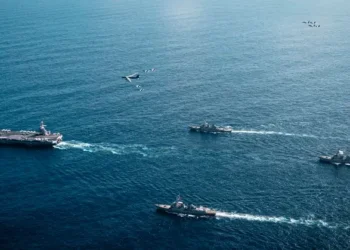

President Donald J. Trump announced the U.S. Navy’s intent to develop a new Trump-class battleship during remarks from Mar-a-Lago in Palm Beach, Florida. The proposed 30,000–40,000-ton warships are designed to revive large surface combatants and anchor a future “golden fleet.”
The announcement signals a potential shift in U.S. naval force structure, emphasizing offensive surface firepower, advanced weapons integration, and domestic shipbuilding amid renewed great-power competition.
Trump Announces New Battleship Program
Trump said he approved a plan for the Navy to begin constructing two new battleships, describing them as the largest the service has ever built. The remarks were delivered from Mar-a-Lago and accompanied by senior administration officials, including Secretary of War Pete Hegseth and Navy Secretary John Phelan.
Additionally, the White House framed the program as a long-term commitment, with the first ship, USS Defiant, targeted for construction in the early 2030s. According to the Navy Department, the vessels remain in the design phase.
President Trump said,
“As commander in chief, it’s my great honor to announce that I have approved a plan for the Navy to begin the construction of two brand-new, very large — largest we’ve ever built — battleships.”
“Trump-Class” and Fleet Expansion Goals
Phelan said the Navy ultimately aims to field between 20 and 25 Trump-class battleships, positioning them as core assets within future battle groups. He stated the ships would revive the offensive role historically associated with battleships.
Meanwhile, Trump described the vessels as central to a broader “golden fleet” concept, intended to expand U.S. maritime power projection across multiple theaters.
Weapons, Capabilities, and Design Features
The administration said the Trump-class battleships would combine traditional naval artillery with advanced strike and defensive systems. Trump stated the ships would be equipped with hypersonic weapons, electromagnetic railguns, and high-powered laser systems.
However, Navy officials have not released technical specifications, including gun caliber, power generation systems, or survivability features. The Navy Department indicated it would lead design efforts in partnership with the U.S. defense industrial base.
Comparison to Previous Battleships
Phelan compared the Trump-class to the Iowa-class battleships, which last saw combat during the 1991 Gulf War. He emphasized a similar focus on offensive firepower, adapted for modern threats.
By contrast, current U.S. surface combatants rely primarily on missile-based systems and distributed lethality concepts, according to Navy doctrine published by the Department of Defense.
Industrial Base and Program Context
Trump stated the battleships would be constructed entirely in the United States by American workers, framing the effort as a job-creation initiative. He said the program would generate thousands of domestic manufacturing jobs.
The Navy confirmed that the Trump-class would replace its previously planned DDG(X) next-generation destroyer, while incorporating capabilities initially intended for that platform.
| Indicator | Recent Movement | Context |
|---|---|---|
| Surface combatant strategy | Program shift announced | Navy Department confirms Trump-class replaces DDG(X), absorbing planned capabilities |
| U.S. battleship usage | No combat use since 1991 | Department of Defense records show Iowa-class ships last used during the Gulf War |
| Ship construction timeline | Early 2030s target | Navy Secretary John Phelan stated first hull planned for next decade |
Oversight and Strategic Implications
The Department of Defense has not yet released budget estimates or confirmed congressional funding pathways. Any formal program would require authorization and appropriations through the House and Senate Armed Services Committees during future defense budget cycles.
Additionally, defense analysts noted that large surface combatants may face increased scrutiny given modern anti-ship missile threats and existing naval modernization priorities outlined in recent Pentagon posture statements.
In a Nutshell
Trump’s announcement outlines an ambitious proposal to reintroduce battleships into the U.S. Navy’s future force structure. The plan emphasizes scale, offensive capability, and domestic production.
Whether the Trump-class advances beyond the design phase will depend on congressional oversight, funding decisions, and alignment with long-term naval strategy.
Sources: U.S. Department of Defense, U.S. Navy, White House.
Prepared by Ivan Alexander Golden, Founder of THX News™, an independent news organization delivering timely insights from global official sources.
Combines AI-analyzed research with human-edited accuracy and context.